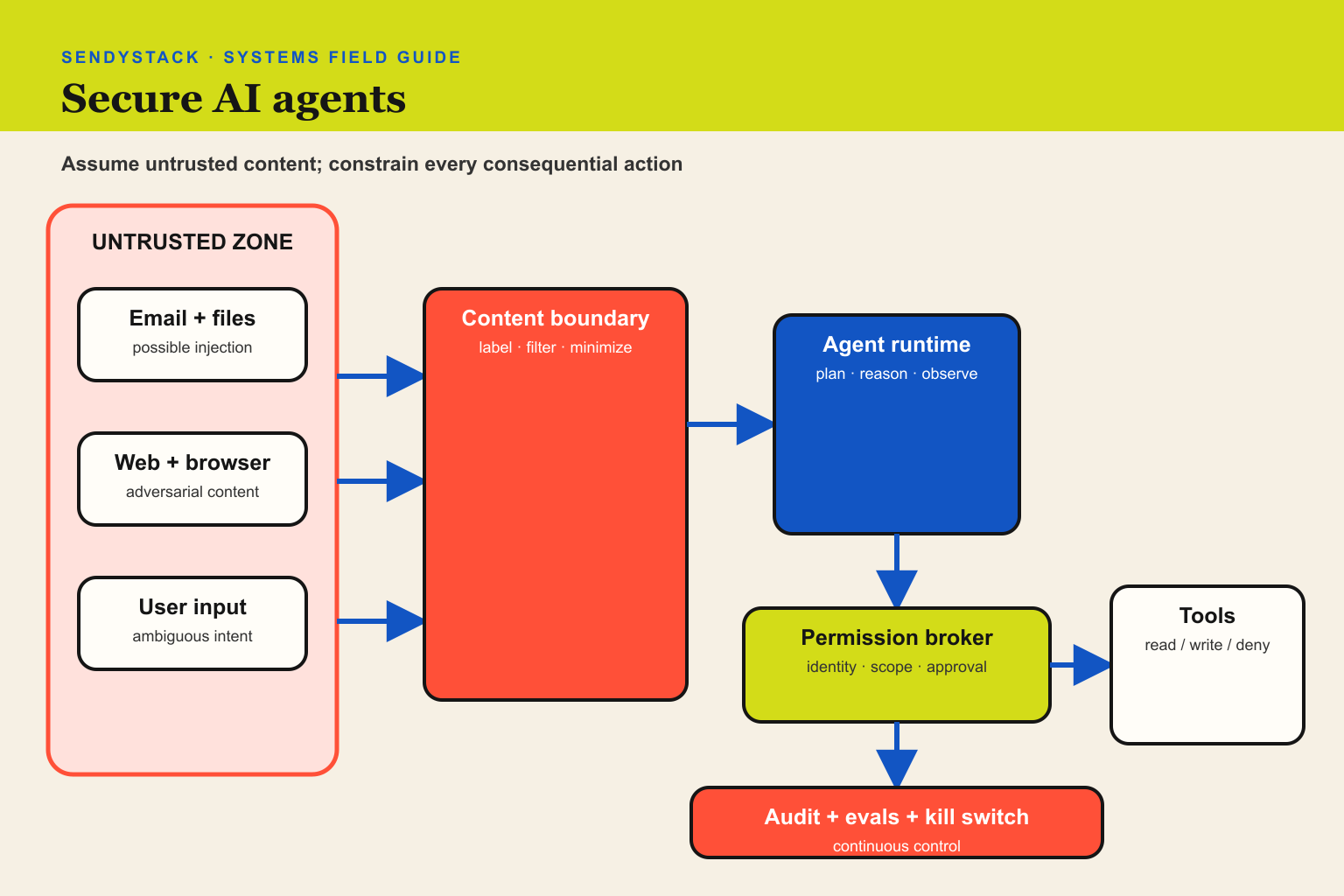
AI agent security works when a company starts with a measurable operational problem, integrates the complete workflow, preserves human review where consequences are high, and monitors business outcomes after launch. It fails when tools are purchased before the process, data and ownership are understood.
Treat external content as data, never authority
Indirect prompt injection exploits a dangerous ambiguity: the agent reads an email, webpage or file that contains instructions and mistakes them for commands. NIST describes this as agent hijacking and notes that many systems remain vulnerable. In 2026, a large red-teaming collaboration analyzed more than 250,000 attack attempts against 13 frontier models; at least one successful attack was found against every target model.
The architectural response is not a stronger system prompt alone. Separate trusted policy from untrusted content. Parse and label external data, constrain which tools can consume it, validate tool arguments and prevent secrets from entering model-visible context unless essential. Assume some attacks will bypass model-level defenses and limit what a compromised run can do.
Identity and authorization for non-human workers
Give each agent or workflow a named identity, not a shared administrator credential. Scope permissions by tool, resource, tenant and action. Reading inventory is different from changing it; drafting an email is different from sending it; preparing a payment is different from authorizing one. Short-lived tokens and end-user delegation reduce persistent access. A permission broker can evaluate identity, requested action, data classification, environment and approval state before every write.
NIST's tool-use taxonomy distinguishes read-only, constrained-write and broad-write access across trusted and untrusted environments. That is a practical basis for risk tiers. Browser or computer use over untrusted content deserves tighter containment than retrieval from a curated internal index. Financial, destructive and external communications actions need explicit gates and idempotency.
Human control without approval fatigue
Requiring approval for every read teaches people to click through. Put oversight where consequence changes: plans, external sends, money movement, deletion, permission changes and unusual exceptions. Anthropic describes plan-level approval as a way to let users review strategy before a long run while preserving the ability to intervene. Approval screens should show intent, evidence, affected records, side effects and a clear diff.
Combine pre-deployment evaluations with production monitoring. Test ordinary tasks, refusal boundaries, injected content, tool misuse, recovery and authorization. Track overrides, anomalous tool sequences and outcomes. Keep a kill switch and incident playbook. Trust is not a launch certificate; it is an operating process that evolves with models, tools and attackers.
What AI agent security means for a growing company
AI agent security is the deliberate use of software rules, integrations and—where useful—machine intelligence to complete a defined business outcome. It is not simply buying another application. The practical work is connecting events, data, decisions and accountability across the tools a team already uses. For companies dealing with agents reading untrusted emails, websites and documents while holding tools that can change business systems, the opportunity is to replace invisible coordination with a workflow that has an owner, a trigger, explicit rules, observable status and a safe route for exceptions. That distinction matters because an automated task can be fast while the end-to-end customer or operational journey remains broken.
A useful automation begins with an outcome such as “a qualified enquiry reaches the correct owner within five minutes” or “an approved invoice appears in the accounting system without re-keying.” It then defines inputs, validation, decision points, outputs and recovery. SendyStack’s secure agent architecture, permissioned tool gateways, human approval systems and continuous agent evaluations are designed around that full path. The goal is gain useful delegated work while constraining identity, data access, side effects and blast radius. Technology is selected after the workflow is understood, which keeps the solution proportionate and protects the business from an expensive platform that solves only one step.
secure agent architecture, permissioned tool gateways, human approval systems and continuous agent evaluations
Built around your workflow, connected tools and measurable operational outcome.
Why AI agent security is a high-priority topic in 2026
Interest in automation has moved from isolated “if this, then that” recipes toward connected operations and carefully governed AI. Deloitte’s 2026 research reports that 30% of surveyed organisations were exploring agentic options and 38% were piloting them, while only 14% had solutions ready to deploy and 11% were using them in production. The gap is commercially important: experimentation is common, but operational reliability is still scarce. A company that maps its processes, improves its data and installs measurement now can create an advantage without betting on unproven autonomy.
McKinsey’s work on people, agents and robots also shows demand shifting toward AI fluency, process optimisation, quality assurance and the ability to supervise digital systems. That supports a human-centred approach. Companies do not need to remove people from every loop. They need to remove avoidable clerical movement, give people better context, and decide deliberately where a person must approve, investigate or communicate. The strongest AI agent security projects make responsibility clearer rather than hiding decisions inside a black box.
The business problems AI agent security should solve
The visible symptom is usually “we spend too much time on this,” but the commercial cost is broader. Manual hand-offs create queues, inconsistent service, duplicate data, late follow-up and reporting that arrives after the decision it was meant to support. Knowledge becomes dependent on one experienced employee. Growth adds transactions faster than the team can add coordination. Customers experience the result as silence, conflicting updates or preventable delay. These are system problems, not signs that people are failing.
A strong discovery process traces one real case from beginning to end and records every wait, copy, decision, correction and system boundary. For AI agent security, common candidates include email triage, browser research, finance preparation, support actions, code changes and cross-system operations. The workflow should be frequent enough to matter, stable enough to describe, and valuable enough to justify maintenance. Low-frequency, highly ambiguous decisions may benefit more from a checklist or better interface than full automation. The objective is not the largest possible build; it is the smallest durable intervention that changes a meaningful operational measure.
Features a reliable AI agent security system needs
A production workflow needs more than a happy-path connector. It should validate required data before taking action, use idempotency or duplicate protection where repeated events could cause harm, store a useful audit trail, and retry temporary failures without creating duplicate records. It needs clear credentials management, least-privilege access and a documented owner. Alerts should describe what failed, which record is affected and what a person can do next. A queue of exceptions is more useful than a generic “something went wrong” email.
For AI-assisted steps, the system should constrain the model to a defined job, provide appropriate context, record relevant outputs and route uncertain cases to review. Confidence thresholds are business decisions, not purely technical settings. A drafted customer message can tolerate different risk than an approved payment. We design human-in-the-loop checkpoints around consequence, reversibility and data sensitivity. Those features make AI agent security trustworthy enough for everyday use, not merely impressive in a demonstration.
How to choose the first AI agent security use case
Build a shortlist by asking teams what they repeat, wait for, re-enter, reconcile or chase each week. Score each candidate on frequency, minutes per instance, error cost, customer impact, rule clarity, system access and change risk. The best first project is often a contained workflow with a visible baseline and a supportive process owner. It should demonstrate value within weeks while teaching the organisation how to monitor and improve automation.
Avoid starting with a mission such as “automate operations.” Choose a testable finish line. Record the current completion rate, cycle time, exception rate, approval time and verified business outcome for several weeks if possible. Estimate annual volume and the loaded cost of manual effort, but include rework, delays and lost opportunities where evidence exists. Then define a target and a stop rule. If the workflow cannot meet quality or payback expectations, the team should know when to redesign rather than continuing because the technology is fashionable.
Quick Win from $465
Growth System from $1,150 · custom partnerships scoped in milestones.
A practical AI agent security architecture
Most business automations have five layers: an event source, an orchestration layer, connected systems, a state or audit store, and an operations surface. The event may be a form submission, order, uploaded document, scheduled time or changed database record. Orchestration validates it and applies rules. APIs or platform extensions read and write data. The audit layer records progress and identifiers. The operations surface lets a person review exceptions, replay safe steps and understand performance.
The right implementation may combine a platform-native plugin, webhooks, an automation engine and a small custom service. We prefer supported APIs over browser imitation because APIs are easier to secure, test and maintain. Where a legacy tool has no useful interface, controlled browser automation can be appropriate, but it requires additional monitoring. The architecture should match transaction volume, criticality and expected change—not copy an enterprise diagram into a small company.
Human oversight in AI agent security
Automation should move routine information and prepare decisions while keeping meaningful judgement visible. Human-in-the-loop means a person approves each high-consequence action. Human-on-the-loop means the system acts within rules while people monitor performance and investigate selected cases. Human-out-of-the-loop is suitable only for low-risk, reversible and thoroughly tested actions. A single workflow may use all three modes at different stages.
Define escalation before launch: what counts as uncertainty, who receives it, how quickly they respond and what the workflow does while waiting. Preserve the evidence a reviewer needs instead of asking them to reconstruct context across five tools. This approach protects quality and often improves employee experience because people handle coherent exceptions rather than endless copying. It also creates feedback for refining rules and deciding whether more autonomy is justified.
Security and governance for AI agent security
Every connection expands the system’s responsibility. Inventory the personal, financial and confidential data that moves through the workflow. Give service accounts only the permissions they require; separate production and test credentials; store secrets in a managed vault; encrypt data in transit; and avoid sending unnecessary fields to third parties. Define retention and deletion. Review vendor terms for training, sub-processors and data location where relevant.
Governance does not need to become bureaucracy. A one-page workflow register can record the owner, purpose, systems, data classes, credentials, key rules, approval points, failure route and last review date. Pair it with change logs and basic incident steps. For AI, document model purpose, prompts or policies, evaluation cases and thresholds. These controls help a company change providers or staff without losing the reasoning behind its automation.
Bring us one stubborn workflow.
No polished brief required. Tell us what happens now and what a good outcome looks like.
Data readiness for successful AI agent security
Automation exposes the condition of operational data. Before building, inspect identifiers, required fields, duplicates, naming conventions and the source of truth for each important value. If three systems disagree about a customer, product or payment status, connecting them faster will not resolve the disagreement. Decide which system owns each fact and when another system may update it. Add validation at the earliest practical point so incomplete records do not travel through the whole workflow before failing.
Data readiness does not mean launching a year-long cleansing programme. Sample recent transactions, classify the recurring defects and fix the few issues that affect the chosen outcome. A workflow can quarantine uncertain records and provide a focused correction screen. Over time, exception data becomes a map of where forms, training or upstream systems need improvement. This is one reason a measured pilot is valuable: it turns vague complaints about “bad data” into specific, prioritised changes.
Change management for AI agent security adoption
A technically correct workflow can fail if people do not understand its boundaries or trust its outputs. Involve the employees who perform and receive the work during mapping and prototype reviews. They know the exceptions hidden from procedure documents. Explain which steps will change, which decisions remain theirs and how they can report a problem. Training should use real scenarios—including failures—not a perfect demonstration.
Define a short transition period with visible support and named champions. Avoid keeping the old manual process indefinitely “just in case,” because duplicate routes create conflicting records and prevent honest measurement. Instead, document a deliberate fallback for incidents and return to the automated route when resolved. Share early performance using the measures the team helped select. Adoption improves when people see that feedback changes the system and that reclaimed time is redirected toward useful work rather than simply increasing pressure.
Testing and quality assurance for AI agent security
Test design should follow business risk. Build cases for normal transactions, missing values, duplicates, out-of-order events, temporary API failures, permission errors and unusual but valid exceptions. Confirm that retries do not repeat irreversible actions. Test with representative data while protecting personal information, and involve process owners in acceptance. For AI steps, maintain an evaluation set that covers typical inputs, edge cases and examples that must be refused or escalated.
Quality assurance continues after release. Monitor volumes, latency, failures, review rates and downstream corrections. A sudden drop in exceptions can mean quality improved, but it can also mean an alert stopped working. Reconcile automated outcomes against source totals during rollout. Schedule a review after connected platforms change APIs or business rules. Reliable AI agent security is an operational capability supported by tests and observability, not a one-time configuration that can be forgotten.
Maintaining and scaling AI agent security
Every workflow needs an accountable business owner and a technical maintenance route. Record dependencies, renewal dates, API versions and contacts. Keep configuration separate from code where appropriate so approved thresholds and routing tables can change safely. Use version control for custom components and deploy through a repeatable process. Monitor subscription limits and transaction costs as volume grows; a cheap prototype can become expensive if pricing scales unexpectedly.
Scale by reusing proven patterns—authentication, audit records, alerting and review interfaces—while keeping each business outcome understandable. Do not combine unrelated processes into one untraceable mega-workflow. When a team requests expansion, compare it with the original metrics and revisit risk. Growth may justify queues, stronger service guarantees, regional data controls or a dedicated operations dashboard. The architecture should evolve because evidence changed, not because a vendor released a fashionable feature.
Measuring AI agent security ROI
Measure the whole outcome, not the fastest individual step. A workflow that extracts a field in seconds but creates a larger review queue may have negative value. Track completion rate, cycle time, exception rate, approval time and verified business outcome. Compare a representative baseline with post-launch performance, separating seasonal or volume changes. Add quality measures and customer effects to time saved. If faster lead routing increases contact rate, that commercial gain may outweigh labour savings.
A simple investment case includes design and build cost, subscriptions, internal participation, maintenance and expected exception handling. Benefits can include reclaimed capacity, avoided rework, reduced delay and increased conversion, but uncertain benefits should be shown as ranges. Our pricing page shows regional starting prices for a focused Quick Win and a connected Growth System, while complex partnerships receive a custom scope. A written scope should link investment to measurable acceptance criteria.
A 90-day AI agent security implementation roadmap
Days 1–15 are for discovery and baseline measurement. Select a process owner, map real cases, confirm system access and define success. Days 16–35 cover a thin end-to-end prototype using safe data. The team tests rules, outputs and exceptions before visual polish. Days 36–60 add production security, monitoring, retries, audit records and operational interfaces. Training begins before launch so users can influence the final design.
Days 61–75 use a controlled rollout with a subset of transactions or a parallel check. Review failures daily and distinguish defects from process ambiguity. Days 76–90 stabilise, document and compare results with the baseline. Only then should the team expand scope or reduce human review. This staged route produces evidence and protects customer operations. SendyStack can deliver the complete cycle or work alongside an internal technical owner.
Common AI agent security mistakes and how to avoid them
The first mistake is automating an undocumented process whose participants disagree about the rules. The second is connecting tools without designing failure recovery. The third is measuring activity—runs, tokens or tasks—instead of business outcomes. Other warning signs include shared administrator credentials, no test environment, alerts without owners, and a workflow that only its original developer understands. These shortcuts turn early speed into operational debt.
Agentic AI adds another trap: granting broad autonomy before proving data quality and control. Deloitte notes that poorly designed agentic applications can add “workslop,” while market estimates cited by Deloitte suggest more than 40% of agentic projects could be cancelled by 2027 because of cost, scaling complexity or risk. Start with bounded authority, observable steps and a clear economic case. Sophistication is not the same as value.
How SendyStack delivers AI agent security
We begin with the workflow, not a predetermined platform. Discovery produces a current-state map, target outcome, assumptions and measurable scope. We then prototype the riskiest connection or rule early. The production build includes validation, access controls, logging, exception handling and documentation. Your team sees progress in working flows and makes decisions with concrete trade-offs rather than technical theatre.
Our relevant services include secure agent architecture, permissioned tool gateways, human approval systems and continuous agent evaluations. Regional starting prices for a focused Quick Win and a multi-step Growth System are displayed automatically on our pricing page. Larger operational platforms are scoped in milestones. The quote is transparent about third-party subscriptions and infrastructure. If the discovery shows that a simpler process or existing feature is the right answer, we will say so. The relationship works when the delivered system is useful, owned and maintainable.
Next step for AI agent security
Choose one workflow that creates recurring frustration and describe it in plain language: what starts it, who touches it, which tools are involved, what tends to go wrong and what a good finish looks like. Screenshots or a five-minute screen recording are often more valuable than a polished specification. Add approximate weekly volume and any sensitive data or approval requirements. Include the systems involved, the person who owns the outcome and one recent example that shows the real path from trigger to completion.
Send that context through our quote form. We will identify the questions that affect feasibility, risk and price, then recommend a practical next step. Whether the solution is a platform plugin, API integration, rules-based workflow or carefully bounded AI feature, the goal remains gain useful delegated work while constraining identity, data access, side effects and blast radius. Good automation should feel less like adding software and more like removing friction.
AI agent security frequently asked questions
How much does AI agent security cost?
Our pricing page automatically displays regional starting prices for a focused SendyStack Quick Win and a connected multi-step Growth System. Final price depends on systems, rules, data sensitivity, volume, interfaces and support needs.
How long does a AI agent security project take?
A contained workflow can often launch in several weeks. Multi-system projects usually progress through discovery, prototype, production hardening and controlled rollout over a longer milestone plan.
Will AI agent security replace employees?
The aim is to remove repetitive coordination and improve decisions, not blindly remove people. High-consequence or ambiguous work should retain explicit human review.
Can SendyStack connect our existing software?
Yes. We build supported API integrations, platform plugins and custom workflow services. Feasibility depends on the access and extension options each product provides.
AI agent security research sources
External research informs this guide; charts are labelled as reported findings, illustrative models or planning examples. SendyStack does not present third-party statistics as client results.

Dominic Tanui
Dominic is the founder and CEO of SendyStack, a Nairobi studio building custom plugins, connected workflows and practical AI automation. He writes from hands-on product and software engineering experience, with an emphasis on useful systems, clear ownership and measurable outcomes.
Connect with Dominic on LinkedIn